USD Savings for Sri Lankans: Protecting Your Money from Currency Volatility
The rupee lost 44% against the dollar in 2022. Learn how USD savings can protect your purchasing power and practical strategies for building dollar savings in Sri Lanka.

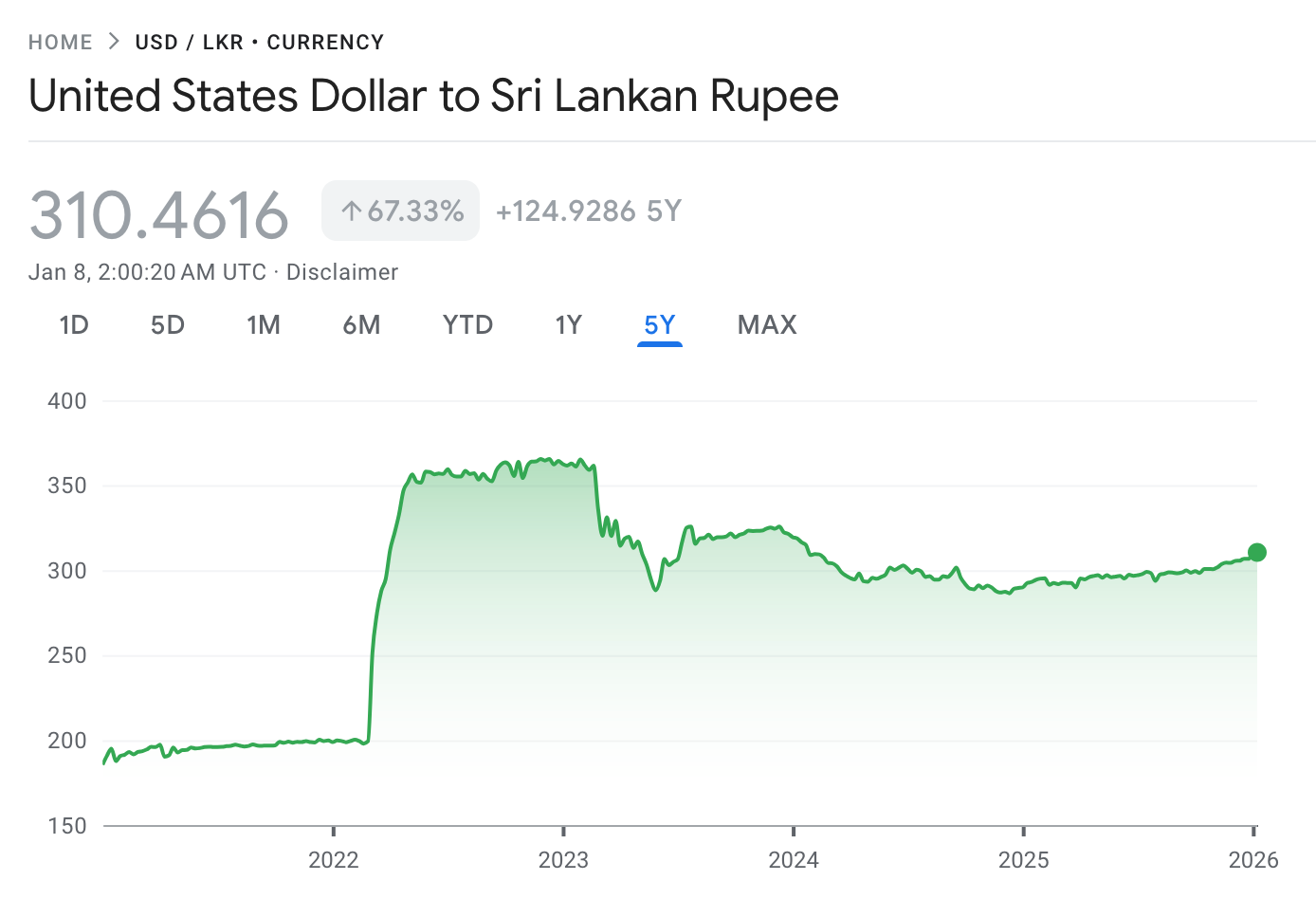
In early 2022, 100,000 LKR was worth roughly 500 USD when the exchange rate was around 200 rupees per dollar.
A few months later, after the major devaluation, the rate moved closer to 360 rupees per dollar. That same 100,000 LKR was suddenly worth only about 278 USD, without you spending a single rupee.
If you were saving for a $500 laptop, overnight your savings were no longer enough. The number in your bank account hadn't changed. But your real buying power had dropped by more than 40% in dollar terms.
This isn't a story about one bad year. This is the reality of currency volatility – and why more Sri Lankans are thinking about USD savings.
Understanding Currency Volatility (In Plain Language)
Currencies move like any other price: when demand for a currency falls or supply rises, it gets weaker. When demand rises or supply tightens, it strengthens.
For Sri Lanka specifically, over the last few years:
Heavy pressure on the rupee: The country's reliance on imports like fuel, medicine, essential goods and obligations to service foreign debt created intense pressure to find dollars. When Sri Lanka needed more USD than it was earning or attracting through exports and investment, the rupee weakened sharply.
Historical context that matters:
In 2022 alone, the rupee lost about 44-45% of its value against the dollar. It was one of the steepest annual depreciations in recent history. The exchange rate moved from around 200 LKR per USD before the float to the mid-300s later that year.
But here's what people often miss: volatility goes both ways. There have been periods where the rupee strengthened again (like parts of 2024) showing that it can swing in either direction, not just downward.
The issue isn't just depreciation. It's unpredictability.
What This Means for Your Daily Life
Imported goods get expensive: Electronics, fuel, medicine – anything that comes from abroad costs more in rupee terms when the currency weakens.
Education abroad becomes harder: University tuition, exam fees like SAT or IELTS, visa applications are all priced in foreign currency. A 20% rupee drop means you need 20% more rupees for the same education expense.
International purchases jump: That Netflix subscription, Amazon order, or domain renewal? The rupee price changes even though the dollar price stays the same.
Your future plans get disrupted: Whether you're saving for a laptop, planning to travel, or building an emergency fund for overseas medical care, rupee volatility directly impacts your ability to achieve those goals.
The question isn't whether the rupee will be volatile. History suggests it will be. The question is: how do you protect yourself?
The Problem With Traditional "Solutions"
You're probably thinking: "Okay, I should get some USD. But how?"
The traditional options exist, but they're awkward for most people:
Foreign Bank Accounts
Many offshore or regional banks require you to maintain several thousand dollars as a minimum balance, charge account maintenance fees, and may require you to visit in person or prove foreign residency.
For a typical Sri Lankan salary earner or freelancer, those requirements are unrealistic. You can't start with $50-100 monthly savings – you need thousands upfront.
Keeping Physical USD at Home
Holding cash under the mattress feels simple, but it has real downsides:
- Security risk: Physical cash can be stolen or lost
- No interest: Your dollars sit idle, not growing
- Exchange friction: When you need rupees, you still have to find a place to exchange at a decent rate
Using Global Payment Platforms
Some international platforms exist in Sri Lanka, but they don't offer the full experience freelancers need.
PayPal in Sri Lanka:
PayPal lists Sri Lanka as a supported country. You can open an account and use it to pay for online purchases with a linked card.
However, Sri Lanka is effectively "send-only" for local accounts. That means users can pay but cannot reliably receive freelance income and withdraw it to a Sri Lankan bank.
Because of these limitations, some people try risky workarounds: using third-party "PayPal dollar buyers" or opening accounts under foreign jurisdictions with forged documents. These hacks breach PayPal's terms and carry real risk of account freezes and lost funds.
Bottom line: PayPal exists, but using it as a primary way to receive and withdraw freelance income into Sri Lankan banks is not straightforward or fully supported.
Wise in Sri Lanka:
Wise supports transfers involving Sri Lanka and lets users hold and convert multiple currencies in a Wise account. Some guides state Wise is "available in Sri Lanka" for sending and receiving internationally.
In practice, the product experience is fragmented:
- No Wise card for Sri Lankan residents: You cannot get a Wise debit card if you live in Sri Lanka, though visitors or people who obtained cards abroad can use them here
- Local bank integration friction: Community reports suggest difficulty linking Sri Lankan bank accounts and sometimes trouble activating accounts due to local bank transfer issues
- Still need on/off ramps to local banks: Even when it works, you're navigating the complexity of getting money in and out through local banks
Wise generally doesn't charge maintenance fees for holding balances, but you pay conversion and transfer fees. Critically, you still have to manage the on/off-ramps with local banks yourself.
Bottom line: Wise works to some extent, but it's not a clean, purpose-built multi-currency account for Sri Lankans with full local integration and card access.
The reality: Many Sri Lankan freelancers resort to informal or risky hacks because the official product offerings are limited. This is exactly the pain point that needs solving.
Local USD Accounts
Sri Lankan banks offer PFCA/BFCA-type foreign currency accounts, but many come with minimum balance requirements, documentation needs, and often very low or no interest on small USD balances.
These accounts can be useful for people who already have significant USD savings. But they're not always designed for someone who wants to start with $50 or $100 a month.
The Gap
There's clearly a gap: an easy way to hold USD digitally with low minimums, transparent conversion, full local withdrawal support, and the ability to use your money when you actually need it.
That's the problem Maash is solving for.
How USD Savings Actually Protect You
Let's look at some concrete scenarios where USD savings change outcomes. These are hypothetical examples based on real rate movements, not specific user stories.
Scenario 1: Saving for a Laptop
Imagine you're planning to buy a $1,000 laptop in six months.
If you only save in rupees:
- You start in Month 1 when the rate is 300 LKR per USD
- You save 50,000 LKR per month
- After 6 months, you have 300,000 LKR total
- At the starting rate, this felt like solid progress toward your $1,000 goal (300,000 ÷ 300 = $1,000)
But by Month 6, the rate has moved to 330 LKR per USD.
- Your 300,000 LKR is now worth: 300,000 ÷ 330 = $909
- You're $91 short of your $1,000 laptop
- You haven't done anything wrong, but the laptop became more expensive in rupee terms faster than you could save
If you save directly in USD instead:
- You save approximately $167 USD per month (at varying rates)
- After 6 months, you have $1,000 USD
- No matter what happens to the rupee during that time, as long as the laptop still costs $1,000 USD, you're covered
The difference: You locked in the price of your goal instead of taking on currency risk.
Scenario 2: Emergency Fund for International Expenses
Emergencies don't wait for good exchange rates.
If you suddenly need to:
- Pay a medical bill abroad
- Support family overseas
- Book a last-minute international flight
- Cover visa fees or unexpected travel
These expenses are usually priced in dollars. If your entire emergency fund is in LKR, a sudden rupee drop can instantly reduce how much you can cover.
Example: You have a 500,000 LKR emergency fund.
- At 300 LKR/USD: That's $1,667 available for use
- Rupee drops to 330 LKR/USD: Now it's only $1,515
- You lost $152 of emergency coverage without spending anything
If part of that fund is in USD, you're less exposed to last-minute FX shocks when you need money most.
Scenario 3: Education Planning
University tuition, exam fees, and international courses are often priced in USD or EUR. If you know you'll need $5,000 in three years, it makes sense to think in that currency now.
Saving everything in LKR means taking on the risk that the rupee could move again right before you need to pay.
Why this matters: Let's say you're saving for a $5,000 international certification program in 3 years.
Rupee savings approach:
- You save 1.5 million LKR over 3 years (assuming stable 300 rate)
- But if rate moves to 330 by payment time: 1.5 million ÷ 330 = $4,545
- You're $455 short despite three years of disciplined saving
USD savings approach:
- You save $5,000 over 3 years
- When payment is due, you have exactly what you need
- Rate fluctuations don't affect your ability to pay
Scenario 4: Long-Term Savings and Retirement
Over 10-20 years, repeated episodes of currency volatility can dramatically change what your LKR savings can buy internationally.
This isn't about speculating on currency movements. It's about recognizing that if you're building wealth for the long term, holding a portion in a currency that has historically held its value better against international goods reduces your exposure to local currency risk.
The US dollar isn't perfect and has its own risks. But for someone living in Sri Lanka planning for international expenses, education, travel, or simply wanting to preserve purchasing power, USD provides a different risk profile than LKR-only savings.
The Simple Principle
Try to save in the currency you'll eventually spend in, or in a currency that better preserves the purchasing power you care about.
If your laptop costs $1,000, save in dollars. If your child's education will be invoiced in USD, save in dollars. If you want stability against rupee volatility, diversify into dollars.
Building a USD Savings Strategy
Here's a practical framework for thinking about currency allocation. These are examples, not financial advice – make sure to consider your own situation when drawing up your own plans.
Not All-or-Nothing
You don't need to convert your entire life savings into dollars overnight. For most people, a balanced approach works better.
Example allocation (adjust based on your personal circumstances):
Keep in LKR:
- 3-6 months of living expenses as your emergency buffer
- This depends entirely on your situation: job stability, dependents, risk tolerance
- If you're a freelancer with variable income, lean toward 6 months
- If you have stable salary and low obligations, 3 months might work
- Upcoming rent, bills, groceries
- Known local purchases in the next month
Build in USD:
- Medium-term goals (6-18 months out)
- Major purchases like electronics or travel
- An additional emergency buffer beyond your LKR cushion
- Part of your long-term savings
This way, you have adequate local currency for security and daily life, plus dollars for stability and international expenses.
Set your starting point
If you earn in LKR
Start by converting 10-20% of your monthly income into USD. Even $50-100 USD per month builds up over time.
Example: You earn 150,000 LKR monthly after tax.
- Convert 15,000-30,000 LKR to USD each month
- At 310 LKR/USD, that's about $48-97 monthly
- Over a year: $576-1,164 in USD savings
- This cushion protects against rupee drops on future purchases
If you earn in USD
Do the opposite: keep most of your earnings in USD and only convert enough LKR each month to cover your local expenses.
Example: You earn $3,000 monthly from US clients.
- Calculate monthly LKR needs: ~150,000 LKR for rent, bills, food
- Withdraw only $485 to cover that (at 310 rate)
- Keep $2,515 in USD
- Your savings grow in dollars automatically
Dollar-Cost Averaging
Trying to "guess" the perfect moment to convert is stressful and usually doesn't work.
Simple habit: Convert a fixed amount every month.
Sometimes you get a slightly better rate, sometimes slightly worse, but over time you average out the volatility. You're not trying to time the market – you're building a habit.
Example: You commit to converting $100 USD worth of LKR each month.
- Month 1: Rate is 305, costs 30,500 LKR
- Month 2: Rate is 315, costs 31,500 LKR
- Month 3: Rate is 310, costs 31,000 LKR
- Total: $300 USD saved, spent 93,000 LKR
- Average rate: 310 LKR/USD
You didn't stress about daily rate movements. You just followed your plan.
Review and Rebalance
Check your LKR/USD mix every 3-6 months rather than watching the rate every morning.
Ask yourself:
- Has my situation changed?
- Do I have upcoming USD expenses I should prepare for?
- Is my LKR buffer still adequate for 3-6 months?
Adjust as needed, but don't obsess daily.
Remember: None of this is investment advice. It's a framework to think about currency risk in your personal financial planning.
How Maash Enables This Strategy
The challenge with traditional options is the barriers: high minimums, fees, complexity, or limited access.
Maash gives you a digital USD account you can access from Sri Lanka, with local US, EU, and UAE virtual bank details to receive money and the ability to hold funds in USD.
Key Features That Enable USD Savings
- No subscription fees or minimum balance requirements: You don't need thousands of dollars to start. Open an account with zero balance and build from there.
- Transparent conversion rates: When you convert between USD and LKR, you see the rate upfront. That rate is typically close to the Google mid-market rate with a clear 1% fee. No hidden markups.
- Flexible withdrawals: When you need rupees, withdraw directly to your local bank account. When you don't, leave your savings in USD.
- Multiple ways to add USD: Whether you earn in USD already or need to convert from LKR, the platform works for both flows.
How Different Users Build USD Savings
If you earn in LKR
Deposit from your local bank into Maash, convert some of that LKR into USD, and build your USD savings month by month.
Example flow:
- Transfer 31,000 LKR from your local bank to Maash
- Convert to approximately $100 USD (at 310 rate)
- Keep in USD balance
- Repeat monthly with dollar-cost averaging in action
If you already earn in USD
Have clients or platforms pay into your Maash USD account. Keep a portion of each payment in USD as savings and only convert what you need for monthly expenses.
Example flow:
- Client sends $3,000 to your Maash US bank account
- You withdraw $485 to LKR for this month's expenses (at 310 rate = ~150,000 LKR)
- You keep $2,515 in USD
- Next month, repeat and watch your USD savings grow
Future Features
Maash is working on ways to let users earn yield on USD balances, targeted around 2026, subject to partners and regulation.
If available, this would make holding USD even more attractive, not just protection from volatility but also growth on your savings.
Maash is a tool that can help you diversify your savings across currencies. It is not a bank and nothing in this article is personal investment advice. Consider your own financial situation, goals, and risk tolerance. Consult a financial advisor for personalized guidance.
Getting Started: A Simple Action Plan
Turn the concept into next steps.
This Week: Calculate your situation
- List your monthly LKR expenses – what absolutely needs to stay in rupees?
- Identify any USD-priced goals in the next 1-3 years (laptop, exam, course, travel, emergency fund)
- Determine what percentage of income you could realistically save in USD
Reality check: If all your expenses are local and all your goals are local, maybe you don't need USD savings. But if you have any international aspirations or want protection from volatility, this is worth exploring.
This Month: Take action
- Download Maash and complete verification
- Start with a small test amount (say $50) to see how the flow works
- If you're a freelancer, set Maash as a payout method on at least one platform or client
Don't overthink it. Start small. See how it feels. Adjust as you go.
Ongoing: Build the habit
- Convert a fixed amount into USD every month (dollar-cost averaging)
- Review your LKR/USD mix every 3-6 months, not every time the rate moves
- Track how your USD savings help you handle at least one real-life expense with less stress
The goal isn't perfection. It's having a strategy that gives you more control and less anxiety about currency movements.
Currency Volatility Won't Go Away, but You Can Prepare
The rupee will continue to fluctuate. Sometimes it strengthens, sometimes it weakens. That's the nature of emerging market currencies in a global economy.
You can't control the exchange rate. But you can control how exposed you are to it.
USD savings aren't about speculation. They're about:
- Matching your savings currency to your future expense currency
- Protecting purchasing power for international goals
- Reducing anxiety when rates move unexpectedly
- Having options instead of being forced to convert at bad moments
This isn't all-or-nothing. You don't need to choose between "all LKR" or "all USD." A balanced approach, keeping local currency for immediate needs and saving dollars for stability and international goals, could give you the best of both.
If you'd like to see what this looks like in practice:
Download Maash to open your global USD account in a few minutes, or read our guide on What Is a Virtual Bank Account? to understand the infrastructure behind the scenes.
Your purchasing power is worth protecting. Start with $50. Build from there. Six months from now, you'll be glad you did.
Disclaimer: This article is for general informational and educational purposes only and does not constitute financial, investment, legal, tax, or other professional advice. Maash is a financial technology platform and is not a bank or investment adviser. Product availability and features may vary by country or region and are subject to eligibility checks, partner terms, and applicable laws and regulations.