What Is KYB? (And why you need that for Maash Business)
Opening a business account requires more than just your company registration. Learn what KYB (Know Your Business) verification is, why it exists, and what documents you'll need.


When you open a personal bank account, you show your ID and prove you're a real person. That's KYC (Know Your Customer).
But what happens when a company wants to open a business account or access cross-border payment services?
Banks and financial platforms can't just ask a company for a selfie. They need to verify that the business itself is legitimate, understand who actually owns and controls it, and assess whether it's safe to work with.
That process is called KYB (Know Your Business).
If you're a founder, freelancer who's incorporated, or small business owner considering services like Maash Business, you'll encounter KYB. It's more complex than personal KYC, and it catches many people off guard.
This guide explains what KYB is, why it exists, what documents you'll typically need, and what to expect as a Sri Lankan business owner navigating this process.
What Is KYB?
Think of it as KYC for businesses, but more complicated.
How KYB Is Different From KYC
KYC is about individual people:
- Name, date of birth, government ID, selfie, proof of address
KYB is about entities and their owners:
- Legal existence (company registration)
- Business address and activity
- Ownership structure
- Ultimate Beneficial Owners (UBOs) – the real people behind the company
Like KYC, KYB sits inside global Anti-Money Laundering (AML) and Counter-Terrorist Financing (CTF) frameworks. It's mandated in jurisdictions like the EU and US, with similar expectations in Sri Lanka through Financial Intelligence Unit (FIU) guidelines.
The key difference: With KYC, one person needs one ID. With KYB, one company might need multiple documents, verification of several people, and proof of complex ownership structures.
Why KYB Exists
You might be thinking: "Why can't I just show my company registration and be done?"
The answer: shell companies and fake entities are widely used for money laundering, sanctions evasion, and corruption.
Without proper verification, criminals can hide behind layers of companies, and banks become unwitting accomplices to financial crime.
What regulators require
Financial institutions must:
- Verify legal existence and business purpose
- Identify and verify Ultimate Beneficial Owners (usually anyone owning/controlling 25% or more)
- Monitor ongoing activity and file suspicious transaction reports
In Sri Lanka, the FIU emphasizes customer due diligence for entities, beneficial owner identification, and enhanced scrutiny for higher-risk sectors like money services, real estate, and cross-border flows.
The bottom line: KYB protects both platforms and legitimate businesses. It's not bureaucracy—it's a legal requirement that keeps the financial system functioning.
What KYB Usually Checks
Here's what financial institutions typically verify during KYB:
1. Basic Business Identity
- Legal name and trading names
- Country of incorporation
- Registration number and date
- Tax registration number
- Legal form (private limited company, partnership, sole proprietorship)
2. Registration Documents
- Certificate of incorporation or business registration
- Articles of association or equivalent documents
3. Addresses
- Registered address: Legal address on official company register
- Operating address: Where the business actually operates (if different)
4. Business Activity
- Description of main activities and industry
- Expected transaction volumes and geographies
High-risk industries trigger additional checks:
- Money services and fintech
- Gambling
- Real estate
- Import/export with certain countries
5. Ownership and Control
- Directors and shareholder (ownership percentage)
- Ultimate Beneficial Owners (UBOs) – the real people who ultimately own or control the entity
6. Supporting Documents
- Shareholder registry or cap table
- Recent Bank statements from the last 90 days
KYB for Sri Lankan Companies
Let's make this concrete for Sri Lankan business owners.
Common Entity Types
- Sole proprietorships / individual business names
- Partnerships
- Private limited companies (Pvt Ltd)
- Branches of foreign companies
Documents You'll Need for Sri Lanka-registered companies
Registration documents:
- Business Registration Certificate (for proprietorships/partnerships)
- Certificate of Incorporation (for Pvt Ltd)
- Forms filed with Registrar of Companies (directors, shareholders, secretary)
Address proof:
- Registered address from eROC records
- Supporting documents like lease, utility bill, or consent letter – if you have a bank statement with the same address, that would work too!
Tax registration:
- TIN from Inland Revenue Department
- VAT registration if applicable
Directors' and owners' identification:
- NIC or passport for all directors and shareholders
- Proof of address for each individual
Shareholder information:
- Shareholder registry showing ownership percentages
- UBO declaration for anyone owning 25% or more
More on Shareholder Registry for Sri Lankan companies
For Sri Lankan Pvt Ltd companies, the "shareholder registry" typically means Form 1 (Application for Registration of a Company) filed with the Registrar of Companies.
Form 1 contains:
- Initial shareholders' names, NIC/passport numbers, and addresses
- Number of shares held by each shareholder
- Initial directors and company secretary details
When Form 1 is sufficient:
- Your shareholders haven't changed since incorporation (most common for startups)
- No shares have been transferred or newly issued
When you need more:
- If ownership has changed: Form 1 + updated share register + ROC filings for transfers
- If shares have been issued: show the complete chain from Form 1 to current ownership
For most early-stage companies using Maash Business, a certified copy of Form 1 is all that's needed.
For Foreign Companies
If incorporated outside Sri Lanka (Delaware C-Corp, Singapore Pte Ltd, etc.), you need equivalent documents from your jurisdiction of incorporation:
- Certificate of incorporation
- Articles of association or bylaws
- Shareholder registry
- Directors' identification
- UBO declarations
Important: Platforms like Maash only require documents from your jurisdiction of incorporation. You don't need both foreign AND Sri Lankan documents, just official paperwork from where your company is legally registered.
Why KYB Feels More Complicated
Different Countries = Different Documents
There's no global "company ID card." A Delaware C-Corp, Singapore Pte Ltd, and Sri Lankan Pvt Ltd all have completely different official forms. Financial institutions must map these to a common compliance framework, which sometimes means:
- Requesting additional documents when formats don't match expectations
- Manual review when automated checks don't cover your jurisdiction
- Follow-up questions to clarify discrepancies
Remote Companies and Proof of Address
Many modern companies operate remotely with a legal registered address (law firm, coworking space) but no traditional office.
KYB often requires proof of your operating address. It means where work actually happens. This can include lease agreements, utility bills, bank statements, or letters from premises owners.
For remote teams:
- You might use a director's home address
- You'll need proper documentation (utility bill, lease, consent letter)
- You may need to explain your remote model
Evolving Document Requests
It's normal for KYB reviews to request additional documents, especially when:
- Activities span high-risk sectors or countries
- Documents are incomplete or inconsistent
- Ownership involves multiple layers
This doesn't mean you've failed. It means the compliance team is doing their job, ensuring they fully understand your structure before approval.
UBO Verification: Don't Overlook This
This is the most important part of KYB, where many applications get stuck.
What Is a UBO?
Ultimate Beneficial Owner (UBO): The real person (or people) who ultimately owns or controls a company, usually anyone owning/controlling 25% or more of shares or voting rights.
Why It Matters
Without UBO checks, criminals hide behind layers of shell companies.
Example:
- Company A (you as director)
- Owned by Company B (shell)
- Owned by Company C (shell)
- Actually controlled by Person X (real UBO)
Global regulations require financial institutions to identify and verify UBOs. Failing this exposes platforms to massive penalties.
For Sri Lankan Founders
For a simple Pvt Ltd:
- You own 100%? You're the UBO
- 50/50 partnership? Both are UBOs
- Three people with 30%, 35%, 35%? All three are UBOs
For complex structures with holding companies:
- Trace ownership through all layers
- Each person with 25%+ control must be identified and verified
- Multiple rounds of documentation may be needed
UBO verification is mandatory. Applications cannot proceed without it.
How KYB Works for Maash Business
 Joyce Chin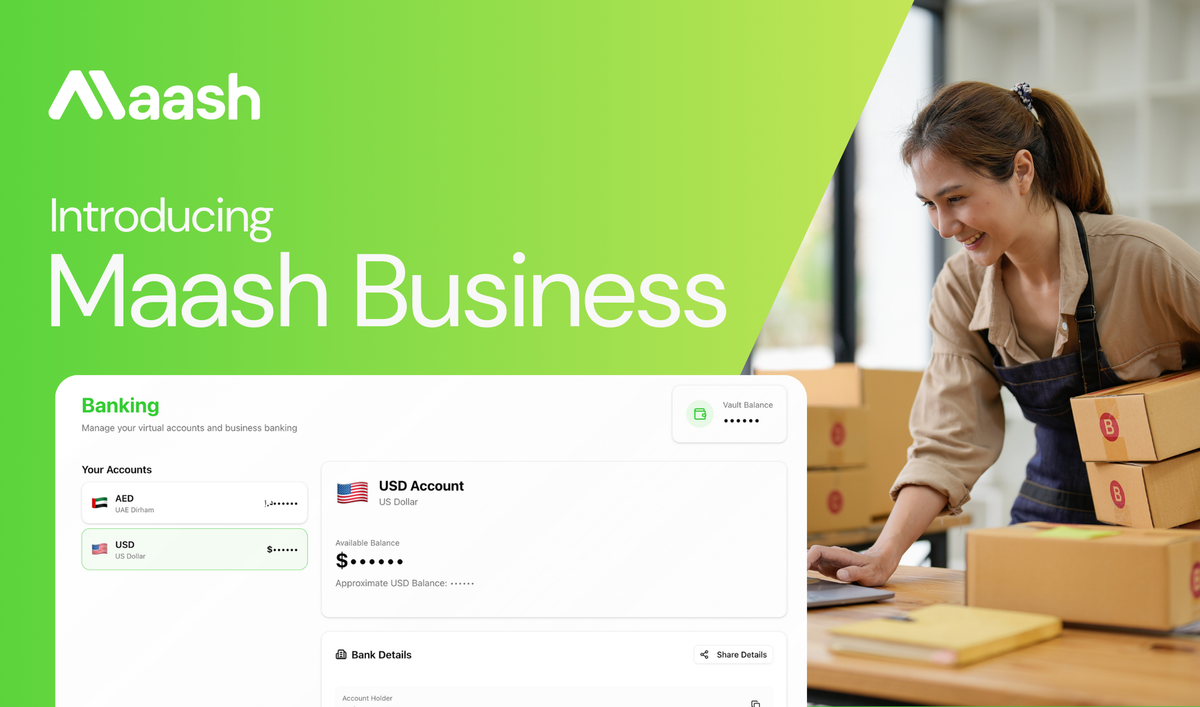
Maash Business helps you run your business with multi-currency bank accounts. That is why we need to collect your business information and documents, then pass them to our regulated banking partners who perform the actual KYB checks.
This is because:
- Maash connects you to licensed banks and payment rails
- Those banks must legally verify every business they serve
- Standards must meet each partner's compliance requirements
The Process
- You provide business information and documents to Maash
- Maash passes this to banking partners
- Partners run checks against registries and sanction lists
- They verify UBOs and run KYC on those individuals
- Approval comes from banking partners, not Maash directly
Why it takes time:
- Different partners have different processing speeds
- Some jurisdictions require manual review
- Complex structures need additional verification
- High-risk industries trigger enhanced due diligence
Document requirements:
- Only documents from your jurisdiction of incorporation
- Singapore company = Singapore docs; Sri Lankan company = Sri Lankan docs
- No dual documentation needed
- UBO verification always required regardless of jurisdiction
Common KYB Issues (And Solutions)
1. Mismatched Information
Problem: Company name, address, or registration number doesn't match official documents.
Fix: Copy details exactly as they appear on official documents. Don't abbreviate or "clean up" formatting. Use the exact legal name and registration details.
2. No Clear Operating Address
Problem: Only a registered agent address with no proof of actual operations.
Fix:
- Use a director's address or coworking space
- Provide lease or utility bill
- Include consent letter if using someone's personal address
- Explain your remote model clearly
3. Missing Shareholder Registry
Problem: No clear document showing ownership percentages.
Fix for Sri Lankan Pvt Ltd:
- If ownership unchanged since incorporation: provide Form 1
- If ownership changed: Form 1 + updated share register + ROC filings
- Ensure documents match stated percentages
- For sole proprietors: clear statement of 100% ownership
What to Expect
Timeline
- Simple structures: Few days
- Complex structures: 2 weeks or longer
Communication
- Follow-up questions are normal, not rejection
- Fast responses = faster completion
- Proactively explain unusual structures
Approval Isn't Guaranteed
Applications may be declined due to:
- Prohibited industries or jurisdictions
- Inability to verify ownership
- High-risk profile beyond partner requirements
- Incomplete or inconsistent documentation
KYB as Your Business "ID Check"
KYB can feel like a hurdle when you're eager to start operations. But here's the reframe: KYB is your business showing its ID. It protects you, your partners, and the financial system.
For Sri Lankan and cross-border founders, it's complex because of different document standards, remote operating models, and UBO documentation requirements.
But there're real benefits to do that. Once verified, you can:
- Access cross-border bank accounts and payment rails
- Move money efficiently globally
- Build credibility with clients and vendors
- Operate through legitimate infrastructure, not risky workarounds
Platforms like Maash work with regulated partners so that once you pass KYB, you have access to proper financial infrastructure.
If You're Unsure
Not sure about:
- Why a document is requested?
- How to prove address for remote operations?
- How to document UBOs for your structure?
- Whether your industry will be accepted?
Reach out to Maash Support. KYB's goal isn't to block legitimate businesses, but to understand them well enough to serve them safely and compliantly.
The process might feel slow, but it's what enables you to operate in the global financial system with confidence – knowing your business has been properly verified by regulated institutions.
Disclaimer: This article is for general informational and educational purposes only and does not constitute financial, investment, legal, tax, or other professional advice. Maash is a financial technology platform and is not a bank or investment adviser. Product availability and features may vary by country or region and are subject to eligibility checks, partner terms, and applicable laws and regulations.